
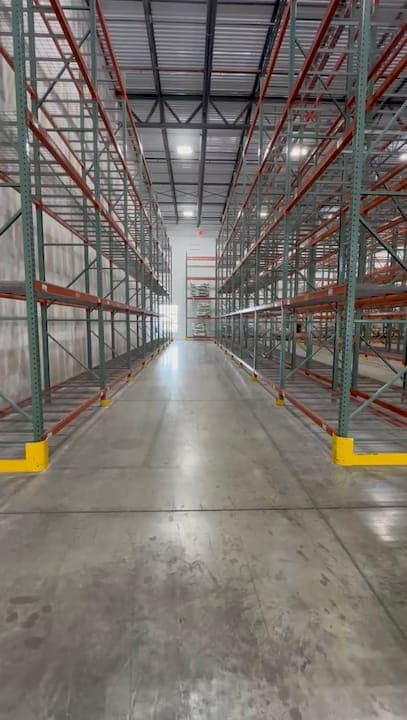

Most logistics managers assume warehousing is straightforward: find space, move goods in, manage the flow. That assumption is costly. Long-term warehousing is a specialized discipline where location, compliance, inventory preservation, and contract flexibility determine whether you protect your margins or quietly erode them. Poor location alone can drive up logistics costs and carbon emissions simultaneously. For import/export companies and e-commerce brands managing complex inventory cycles, getting long-term warehousing right is not optional. This guide walks you through what it means, why it matters, where the real risks hide, and how to build a warehousing strategy that actually supports your growth.
Table of Contents
- What is long-term warehousing?
- Key benefits of long-term warehousing
- Critical challenges and common pitfalls
- Best practices for long-term warehousing success
- Why strategic warehousing choices set leaders apart
- Supercharge your logistics with expert long-term warehousing
- Frequently asked questions
Key Takeaways
| Point | Details |
|---|---|
| Long-term warehousing defined | It means extended storage focused on compliance, preservation, and strategic inventory control. |
| Biggest benefits | It smooths inventory, lowers logistics costs, and supports business growth for import/export and e-commerce firms. |
| Common pitfalls | Ignoring compliance, location, or facility limits can quickly erode warehousing ROI. |
| Best practice essentials | Success relies on provider alignment, robust monitoring, and regular compliance checks. |
| Expert help matters | Partnering with specialists mitigates risk and unlocks strategic value in long-term warehousing. |
What is long-term warehousing?
Long-term warehousing refers to the storage of goods for extended periods, typically beyond 90 days, within a facility designed to support inventory preservation, compliance, and cost-effective access over time. It is fundamentally different from short-term or transactional storage, where rapid turnover is the priority.
Who uses it? The primary users fall into two groups:
- Importers and exporters who need time to clear customs, consolidate shipments, or manage fluctuating demand across international markets
- E-commerce brands that pre-position inventory ahead of peak seasons, manage slow-moving SKUs, or buffer against supply chain disruptions
Long-term warehousing is not a single product. It spans several specialized formats:
- Standard pallet storage for general merchandise with controlled access
- Bonded warehousing, where goods are stored under customs supervision and duties are deferred until the goods enter commerce. Bonded facilities require strict import compliance and meticulous recordkeeping to remain in good standing with customs authorities
- Climate-controlled storage for temperature-sensitive goods
- Value-added storage that includes labeling, kitting, or repackaging as part of the warehousing agreement
One of the most persistent misconceptions is that all warehouses are interchangeable. They are not. A facility optimized for fast-moving consumer goods is not equipped to handle bonded inventory or hazardous materials. Specialization, location relative to ports and freight corridors, and compliance history all determine whether a warehouse is the right fit for your specific operation.
When evaluating long-term warehousing solutions, ask detailed questions about liability coverage, cargo insurance requirements, handling procedures for your specific product types, and what happens to your goods if the provider changes ownership or goes out of business.
Pro Tip: Before signing any long-term storage agreement, request a written breakdown of liability limits, insurance requirements, and damage claim procedures. Verbal assurances are not enough when your inventory is on the line for six months or more.
Key benefits of long-term warehousing
With a working definition in place, let's look at why leading logistics teams prioritize long-term warehousing and what benefits they actually realize.
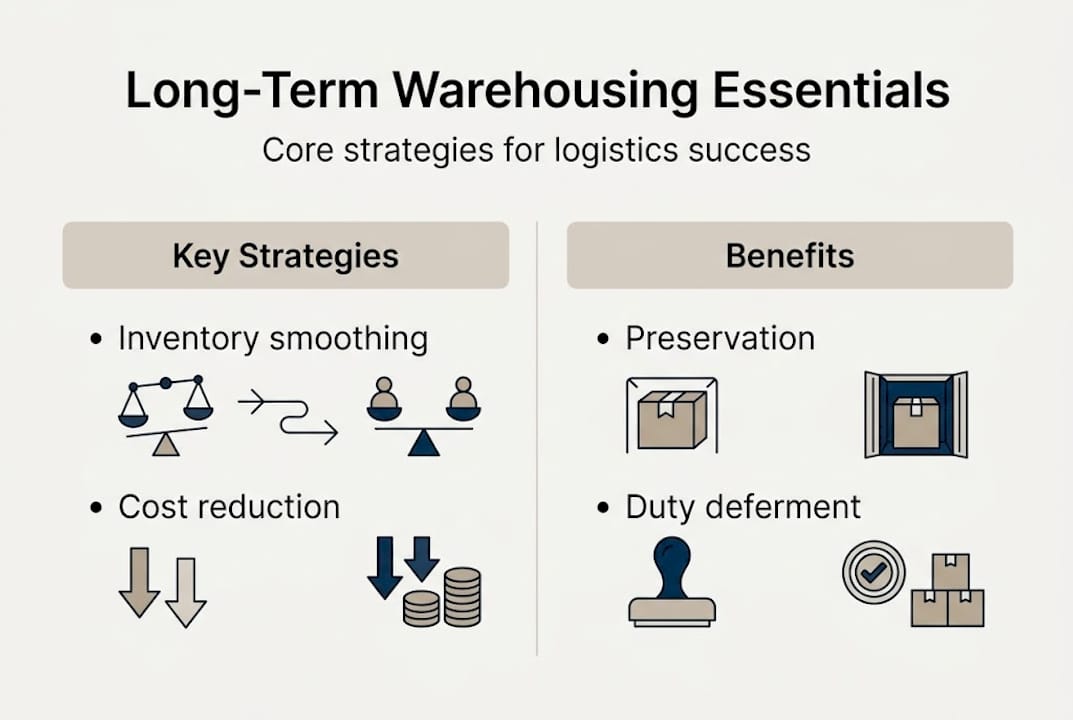
The most immediate benefit is inventory smoothing. Demand is rarely linear. Seasonal spikes, promotional surges, and supply chain delays create pressure that short-term storage cannot absorb. Long-term warehousing gives you a buffer. You can receive large container shipments when freight rates are low, store inventory strategically, and fulfill orders on your schedule rather than reacting to market volatility.
This directly reduces last-minute logistics costs. When you are not scrambling to find space or expediting shipments to cover a stockout, your freight planning improves and your per-unit shipping cost drops. Brands that pre-position inventory in well-located warehouses consistently pay less per shipment than those managing inventory reactively.
Inventory preservation is another underrated benefit. Long-term facilities that specialize in extended storage invest in racking systems, climate controls, and handling protocols that protect goods over time. Proper storage reduces product damage, shrinkage, and obsolescence. Slow-moving inventory risks deterioration and damage when placed in facilities not designed for extended holds.
For importers and exporters, bonded warehousing offers a significant financial advantage: deferred duty payments. Instead of paying customs duties at the point of entry, you pay when goods are released for sale. This improves cash flow, especially for high-value or high-volume shipments.
Here is a practical cost comparison over a 12-month period:
| Storage type | Average monthly cost per pallet | Flexibility | Compliance support | Best for |
|---|---|---|---|---|
| Short-term storage | $35 to $60 | High | Minimal | Fast-moving goods |
| Long-term storage | $20 to $35 | Moderate | Strong | Seasonal, bonded, bulk |
| On-site warehousing | $50 to $100+ | Full | Self-managed | Large operations only |
The numbers are clear. Long-term third-party warehousing consistently delivers lower per-pallet costs than short-term alternatives or maintaining your own facility, especially when you factor in overhead, staffing, and compliance management.
Brands that shift from reactive short-term storage to planned long-term warehousing typically report 15 to 25 percent reductions in total logistics spend within the first year, driven by better freight planning, fewer emergency shipments, and lower per-unit storage rates.
Critical challenges and common pitfalls
While the benefits are significant, long-term storage also introduces new operational complexities, even for experienced logistics teams.
Here are the five most common mistakes managers make with long-term warehousing:
-
Overlooking compliance paperwork. Bonded warehousing and import storage require precise documentation. Missing or incorrect HS codes, inaccurate manifests, or lapsed permits can trigger customs holds, fines, or forced disposal of goods. Quick fix: assign a dedicated compliance contact and audit documentation quarterly.
-
Choosing a facility based on price alone. The cheapest rate rarely accounts for location inefficiencies, limited operating hours, or inadequate security. A warehouse 40 miles from your primary port may cost less per pallet but add significant drayage costs on every movement. Quick fix: calculate total landed cost, not just storage rate.
-
Ignoring facility limitations. Over-automation and ignoring structural limits are among the most common expansion mistakes in warehousing. A facility's ceiling height, dock capacity, and fire suppression systems all affect what you can store and how efficiently you can access it. Quick fix: conduct a physical site visit before committing.
-
Failing to monitor slow-moving inventory. Goods stored for extended periods without regular cycle counts can deteriorate, expire, or become obsolete without anyone noticing until it is too late. Quick fix: implement monthly inventory reporting with your provider.
-
Neglecting contract flexibility. Long-term agreements that lock you into fixed pallet minimums or rigid access windows can hurt you when business conditions change. Quick fix: negotiate quarterly review clauses and scalable storage tiers.
| Risk factor | Short-term warehousing | Long-term warehousing |
|---|---|---|
| Inventory obsolescence | Low | High if unmonitored |
| Compliance exposure | Low | High without audits |
| Cost overruns | Moderate | Low with planning |
| Location impact | Minimal | Significant |
| Contract rigidity | Low | Moderate to high |
"Poor facility location does not just increase freight costs. It compounds over time, adding emissions, delays, and hidden fees that erode margins on every single shipment."
Pro Tip: Schedule a formal compliance audit with your warehouse provider every quarter. Review documentation accuracy, inventory condition reports, and SLA performance. Catching small issues early prevents expensive disruptions later.
Best practices for long-term warehousing success
Knowing the pitfalls, let's focus on how to make long-term warehousing work for your operation in a practical, results-driven way.
Selecting the right facility starts with four criteria:
- Location relative to your freight nodes. Proximity to ports, airports, and major freight corridors directly affects drayage costs and transit times. A facility inside a recognized freight corridor gives you faster, cheaper access to your goods.
- Specialization and compliance history. Ask for references from importers or e-commerce clients with similar product types. A provider with a clean customs compliance record is worth paying a slight premium for.
- Technology capabilities. Your warehouse provider should offer a warehouse management system (WMS) that integrates with your inventory and order management platforms. Real-time visibility into stock levels, lot numbers, and expiration dates is not a luxury for long-term storage. It is a requirement.
- Contract flexibility. Look for agreements that allow you to scale up or down without punitive fees. Your storage needs in Q4 will likely look very different from Q2.
Once you are operational, ongoing management is what separates efficient warehousing from expensive warehousing. Here are four steps every logistics manager should implement:
- Run monthly cycle counts and reconcile them against your WMS data. Discrepancies caught early are easy to resolve. Discrepancies caught after six months become write-offs.
- Review your SLA performance quarterly. Are orders being picked and shipped within agreed windows? Is damage occurring at acceptable rates? Hold your provider accountable to written benchmarks.
- Audit your insurance coverage annually. Cargo values change. Your coverage should reflect current inventory value, not what you agreed to at contract signing.
- Integrate warehousing data with your order management system. Bonded warehousing requires diligent compliance and robust recordkeeping, and the same principle applies to all long-term storage. Connected systems reduce manual errors and give you the data you need to make smart replenishment decisions.
If you are operating in South Florida, Medley FL warehousing positions you within direct reach of PortMiami and Miami International Airport, which is a significant advantage for importers managing container-level shipments.
Why strategic warehousing choices set leaders apart
Most logistics managers evaluate warehouses on two metrics: square footage and monthly rate. That is understandable. Budget pressure is real. But the managers who consistently outperform their peers are not the ones who found the cheapest space. They are the ones who aligned their warehousing strategy with their business model and growth trajectory.
We have seen brands choose a slightly higher-cost facility near a major port and reduce their total annual logistics spend by more than 20 percent, simply because every container movement cost less and happened faster. We have also seen brands lock into cheap, remote storage and spend the savings on emergency drayage within six months.
The uncomfortable truth is that flexibility and compliance support are worth more than raw capacity. A warehouse that grows with your business, keeps your customs paperwork clean, and gives you real-time inventory visibility is a strategic asset. A warehouse that just holds pallets is a liability waiting to surface.
Our 3PL warehousing expertise is built around this philosophy. The right provider is not the biggest or the cheapest. It is the one that fits your operation and scales with it.
Supercharge your logistics with expert long-term warehousing
If optimizing long-term warehousing is on your agenda, choosing the right partner is your next critical step.
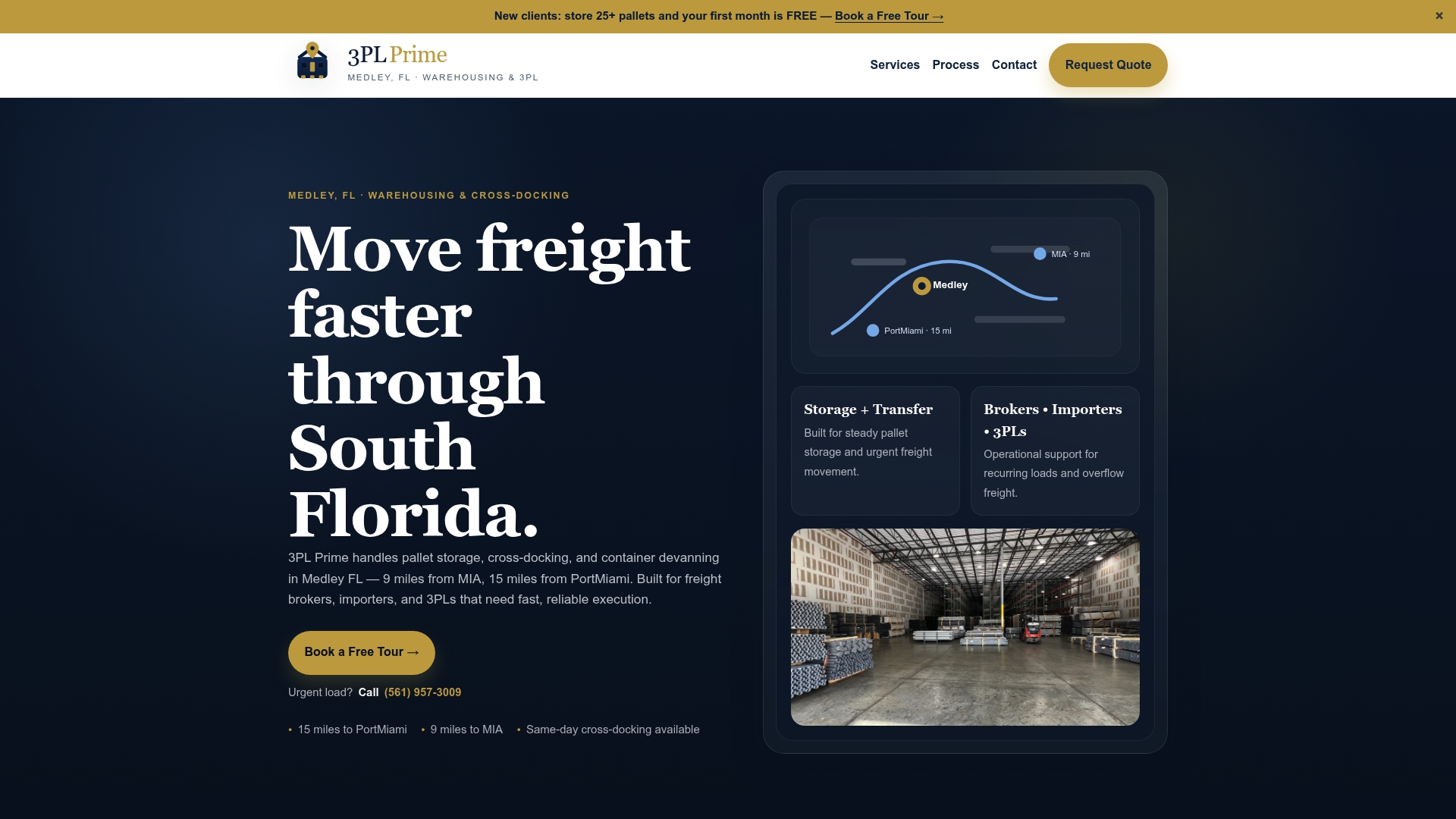
At 3PL Prime, we built our operation around exactly the challenges and best practices covered in this guide. Our Class A Prologis facility in Medley, FL sits 9 miles from Miami International Airport and 15 miles from PortMiami, putting your inventory inside South Florida's primary freight corridor. We offer flexible pallet storage from $20 per pallet per month with no setup fees, same-day cross-docking, container devanning, and full compliance support. New clients storing 25 or more pallets get their first month free. Explore 3PL Prime warehousing and book a no-obligation facility tour at 3plprime.com or call (561) 957-3009.
Frequently asked questions
How does long-term warehousing differ from short-term warehousing?
Long-term warehousing is designed for extended storage with enhanced compliance protocols, inventory preservation systems, and strategic cost structures, while short-term storage prioritizes rapid turnover and transactional flexibility. Structural limits and compliance are critical factors that distinguish facilities built for long-term holds.
What are the biggest risks in long-term warehousing?
The primary risks are inventory obsolescence, compliance failures, facility constraints, and elevated logistics costs from poor location decisions. Slow-moving inventory and poor location consistently rank as the top cost drivers in long-term storage operations.
Why do import/export companies use bonded long-term warehouses?
Bonded warehouses allow importers to defer customs duty payments until goods enter commerce, improving cash flow on high-value shipments. Bonded facilities are valuable but require strict recordkeeping and regular compliance audits to avoid penalties.
Can e-commerce brands benefit from long-term warehousing?
Yes. E-commerce brands use long-term warehousing to pre-position seasonal inventory, reduce per-unit shipping costs, and buffer against supply chain disruptions. Inventory smoothing is a major benefit that helps brands manage demand spikes without resorting to expensive expedited shipping.